Illinois EMS protocols,
in your pocket.
Offline, county-specific protocols for Illinois EMS providers — searchable, with a full medication reference, hospital finder, and study tools built in.
Protocols current as of October 16, 2026
See it in the field
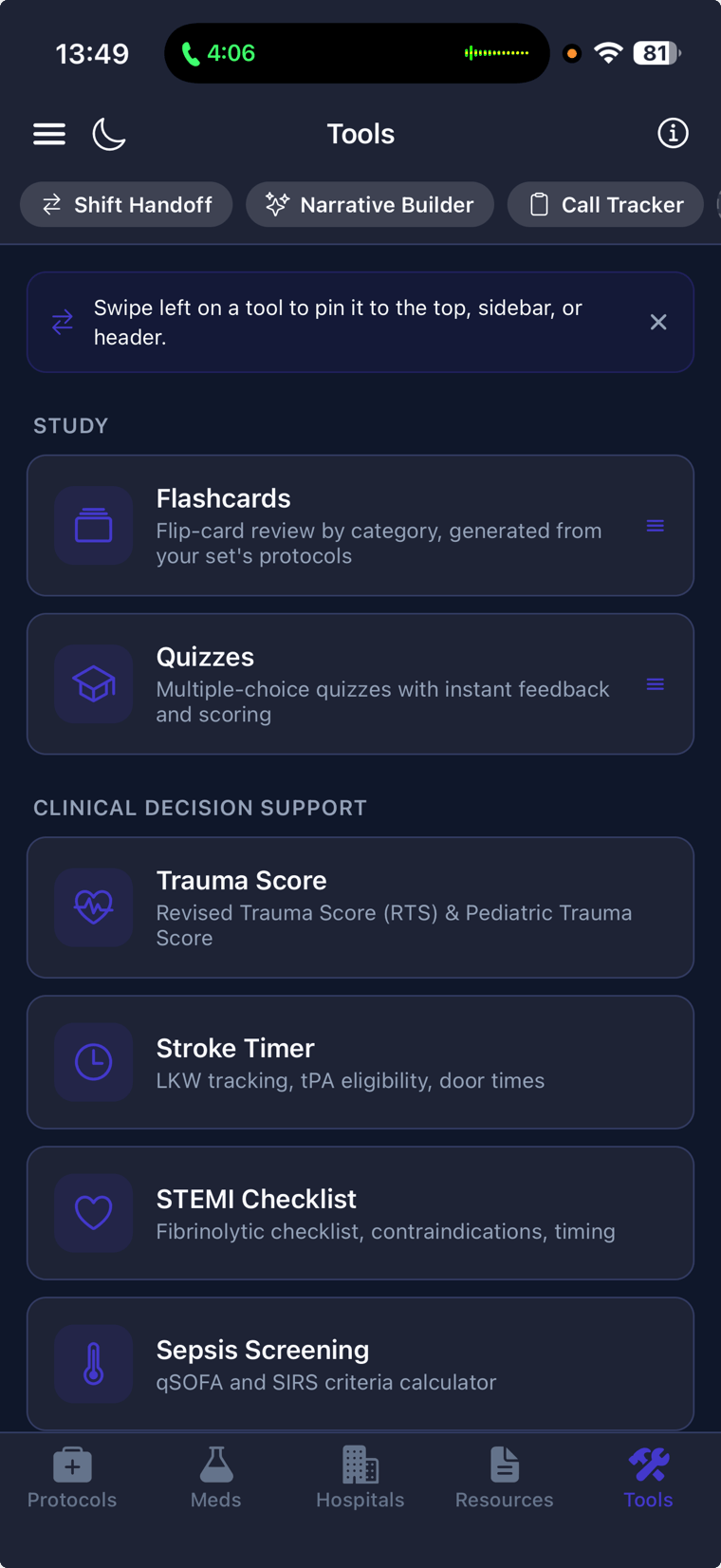
Pocket Protocols showing Illinois's protocols, medications, and hospitals — searchable and fully offline.
What's covered in Illinois
The protocol sets serving Illinois right now.
Chicago EMS System (Region 11) ALS
Chicago EMS System (Region 11) BLS
East Central Illinois EMS System Adult Protocol Manual
Study tools for Chicago EMS System (Region 11) ALS
A few real flashcards and quiz questions from Illinois's own protocols — the full set, plus a spaced-review deck, is in the app.
Flashcards
Estimating gestational age when unknown: fundal height landmark
Adult Bradycardia – Inclusion Criteria
Inclusion criteria for Adult Tachycardia with a Pulse protocol
Definition of Syncope (per protocol)
Assessing perfusion in a VAD patient: why standard vitals may be unreliable
Initial defibrillation energy for V-fib/Pulseless V-tach
ALS cardiac monitoring requirement in electrical injury assessment
ECG Rhythms Classified as Bradycardia
Quiz questions
According to the Chicago EMS System ACS protocol, within what time frame must EMS clinicians acquire a 12-lead ECG for all patients exhibiting signs and symptoms of ACS?
- Within 5 minutes
- ✓ Within 10 minutes
- Within 15 minutes
- Within 20 minutes
According to the protocol, which of the following BEST describes the definition of syncope?
- Prodromal symptoms such as pallor, sweating, and lightheadedness that precede loss of consciousness
- ✓ Both the loss of consciousness and the loss of postural tone that resolves spontaneously without medical interventions
- Any altered mental status that does not resolve within minutes without intervention
- Loss of consciousness with persistent neurologic deficit after the event
A VAD patient is found unresponsive and apneic with no signs of life. According to the protocol, which of the following statements about defibrillation is correct?
- Defibrillation is contraindicated in all VAD patients
- ✓ Defibrillation may be performed, but pads must not be placed over the device
- Defibrillation may be performed, and pad placement is unrestricted
- Defibrillation requires VAD Coordinator approval before use
In the V-fib/Pulseless V-tach - ALS protocol, how often is Epinephrine 1 mg (1 mg/10ml prefilled syringe) IV/IO repeated?
- Every 3 minutes
- ✓ Every 5 minutes
- Every 10 minutes
- It is given only once
Lightning Strike Injuries: which cardiovascular assessment findings are listed?
- Bradycardia and persistent hypotension
- ✓ Dysrhythmias and transient hypertension
- Murmurs and jugular venous distension
- Chest pain and pericardial rub
In Pediatric VF / Pulseless VT - ALS, after the first 2 J/kg shock, what energy is used for subsequent defibrillations?
- ✓ 4 J/kg
- 2 J/kg
- 6 J/kg
- 10 J/kg
Sourced from Illinois's EMS authority
Pocket Protocols brings Illinois's EMS protocols into a faster, fully offline app.
Illinois protocols — FAQ
Are Illinois's EMS protocols available offline?
Are the protocols specific to my county in Illinois?
Is Pocket Protocols official, or affiliated with Illinois?
How do Illinois protocol updates reach the app?
Carry Illinois's protocols on every call.
Download Pocket Protocols and keep your county's complete protocol set in your pocket — online or off.