Live in Kansas
Kansas EMS protocols,
Kansas EMS protocols,
in your pocket.
Offline, county-specific protocols for Kansas EMS providers — searchable, with a full medication reference, hospital finder, and study tools built in.
Protocols current as of October 16, 2026
See it in the field
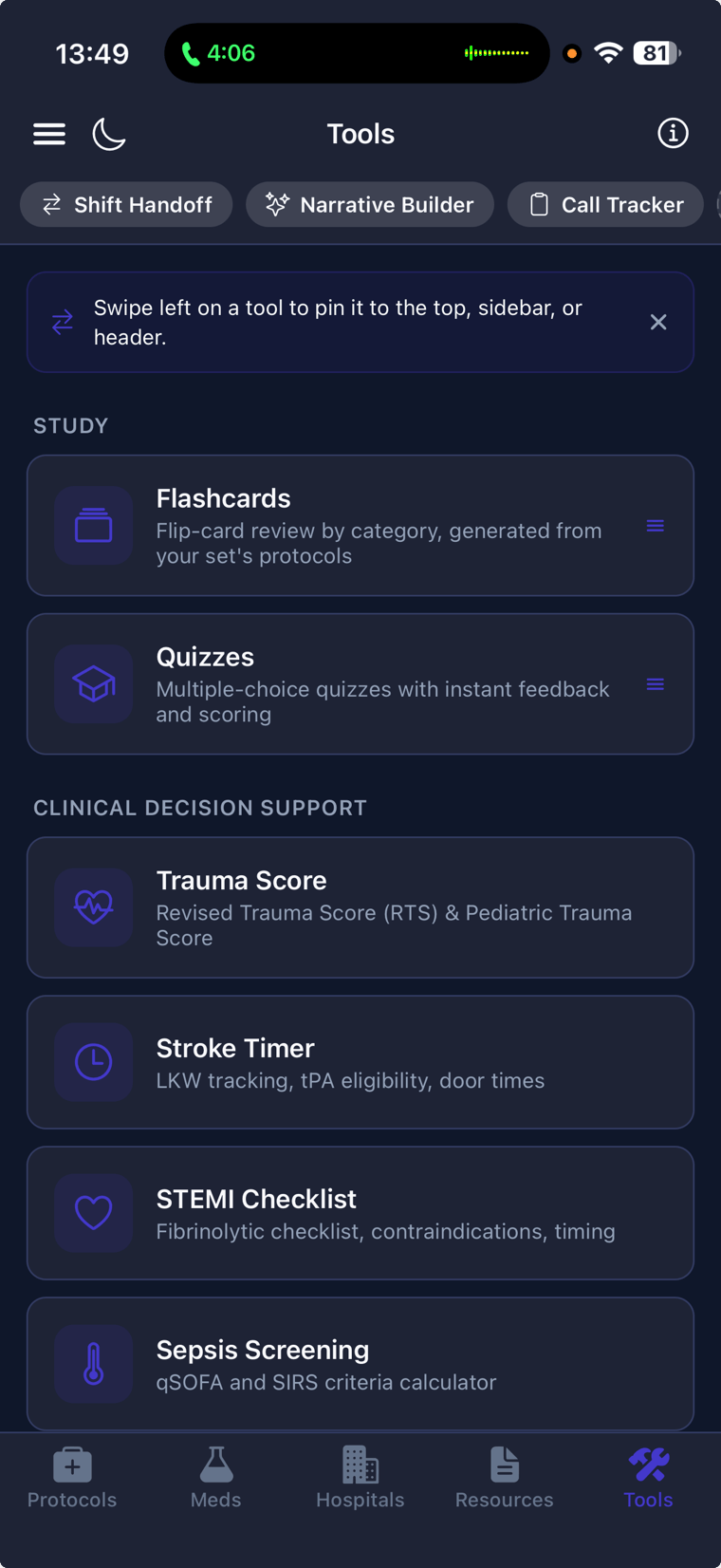
Pocket Protocols showing Kansas's protocols, medications, and hospitals — searchable and fully offline.
What's covered in Kansas
The protocol set serving Kansas right now.
Johnson County EMS System
Patient Care Protocols 2026 ↗
PDF document
578
Flashcards
365
Quiz questions
32
Medications
1
Resource
Study tools for Johnson County EMS System
A few real flashcards and quiz questions from Kansas's own protocols — the full set, plus a spaced-review deck, is in the app.
Flashcards
Dysrhythmias (Bradycardia): presentation
Heart rate < 60 bpm with symptoms (altered mental status, chest pain, CHF, seizure, syncope, diaphoresis, etc.) and/or hemodynamic instability.
Dysrhythmias (Tachycardia): stable regular narrow complex (SVT)
Vagal maneuvers (modified Valsalva in patients able to follow instructions); consider adenosine if unsuccessful.
Syncope and PreSyncope: definition of syncope
Syncope = loss of consciousness and postural tone, typically resolving when supine.
Ventricular Assist Devices (VADs): CPR decision
Do not perform CPR if the pump is clearly functioning; use best clinical judgment and in consultation with the VAD companion and/or VAD coordinator (or Direct Medical Oversight if coordinator unavailable) to determine when to perform CPR. Initiate CPR if the pump has stopped and troubleshooting failed AND the patient is unresponsive with no signs of life.
Drowning: ABC approach in cardiac arrest
Unlike the CAB strategy used in standard cardiac arrest, patients suffering cardiac arrest from drowning require an ABC approach with prompt airway management and supplemental breathing.
Electrical Injuries: AC vs DC
AC is more likely to cause cardiac dysrhythmias, particularly V-fib; DC is more likely to cause asystole and deep burns. DC typically causes one muscle contraction while AC can cause repeated contractions.
Adult Cardiac Arrest: compression depth
Adults: at least 2 inches (5 cm). Adolescents who have entered puberty should receive adult compression depth.
Post-ROSC Care: oxygen saturation target
Administer oxygen to target SpO₂ 94–98%. Avoid hyperoxygenation; the goal is NOT 100% saturation.
Quiz questions
Per the Shock protocol, in cardiogenic, hypovolemic, obstructive, and suspected septic shock, a vasopressor is titrated to which adult target?
- MAP >65mmHg or SBP >90mmHg
- ✓ MAP >70mmHg or SBP >100mmHg
- MAP 85-90mmHg
- SBP >120mmHg
Per the Dysrhythmias (Tachycardia) protocol, what is the treatment listed for Torsades de Pointes?
- Adenosine
- Vagal maneuvers
- ✓ Perform Defibrillation
- Monitor only
Per the Syncope and PreSyncope protocol, which age is listed as a high-risk feature?
- Age ≥ 40
- Age ≥ 50
- ✓ Age ≥ 60
- Age ≥ 75
Per the Ventricular Assist Devices (VADs) protocol, what is the most common VAD alarm cause?
- Pump thrombosis
- ✓ Low battery/power failure
- Driveline infection
- Controller software error
Per the Drowning protocol, patients in cardiac arrest from drowning require which approach?
- CAB, as in standard cardiac arrest
- Compressions only until hospital arrival
- In-water chest compressions during rescue
- ✓ ABC, with prompt airway management and supplemental breathing
Per the Electrical Injuries protocol, which current type is more likely to cause cardiac dysrhythmias, particularly V-fib?
- DC
- Both are equally likely
- ✓ AC
- Neither causes dysrhythmias
Sourced from Kansas's EMS authority
Pocket Protocols brings Kansas's EMS protocols into a faster, fully offline app.
Kansas protocols — FAQ
Are Kansas's EMS protocols available offline?
Yes. Download the protocol set for your area once and every protocol, medication, and hospital is available with no signal — built for basements, rural calls, and dead zones.
Are the protocols specific to my county in Kansas?
Pocket Protocols covers selected areas in Kansas today, not the whole state. Protocol sets are scoped by county, so a provider in a covered county gets exactly the set that governs where they respond, and you can add more than one if you work across areas. Other counties are added as their EMS authorities come on board.
Is Pocket Protocols official, or affiliated with Kansas?
No — Pocket Protocols is an independent app and isn't affiliated with or endorsed by any EMS authority. We bring Kansas's protocols into a faster, fully offline app and link the authority's own source for every set.
How do Kansas protocol updates reach the app?
When the EMS authority publishes a new version and it goes live in Pocket Protocols, the app refreshes automatically — crews are never working from a stale copy. We monitor official sources for changes every day.
Carry Kansas's protocols on every call.
Download Pocket Protocols and keep your county's complete protocol set in your pocket — online or off.