Live in Texas
Texas EMS protocols,
Texas EMS protocols,
in your pocket.
Offline, county-specific protocols for Texas EMS providers — searchable, with a full medication reference, hospital finder, and study tools built in.
Protocols current as of October 16, 2026
See it in the field
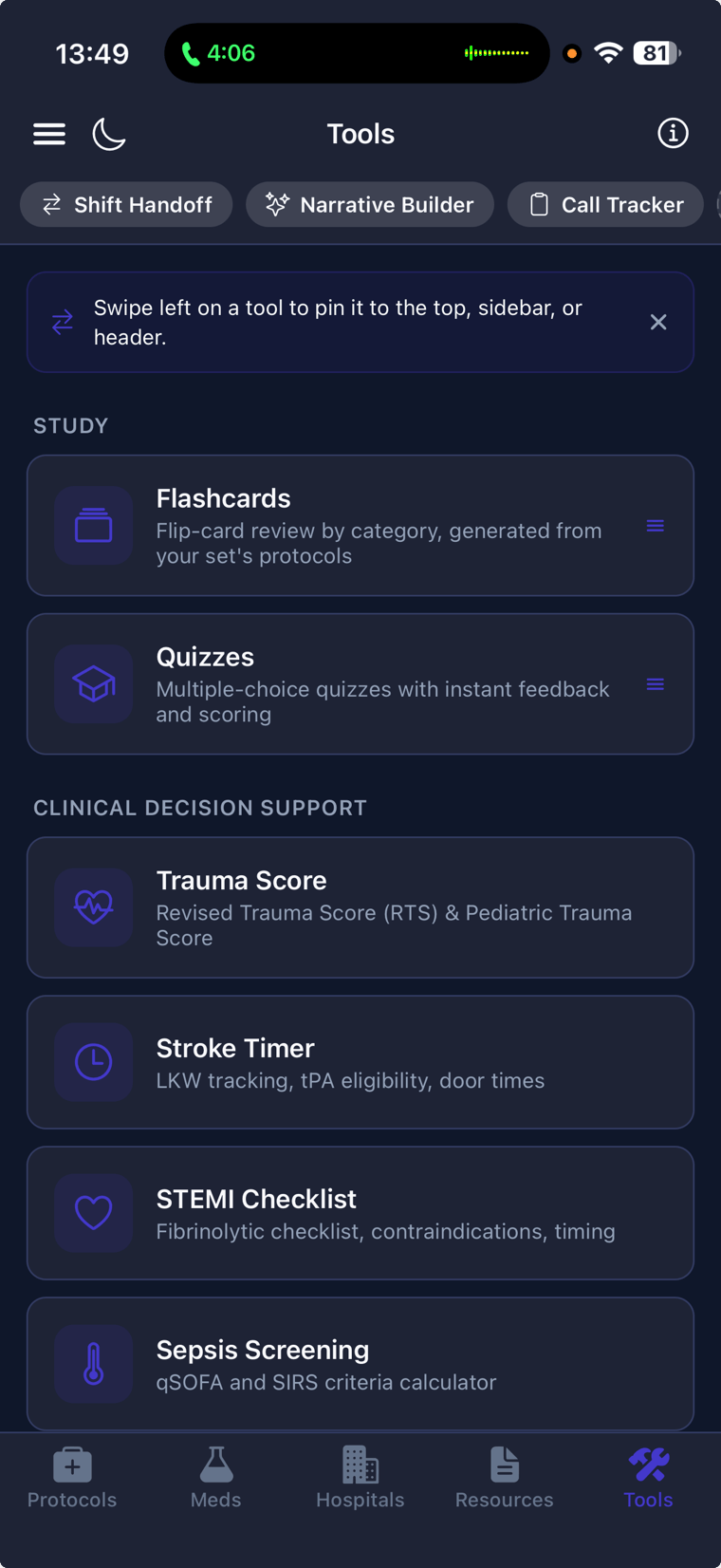
Pocket Protocols showing Texas's protocols, medications, and hospitals — searchable and fully offline.
What's covered in Texas
The protocol set serving Texas right now.
Montgomery County Hospital District (MCHD) EMS
Mar 2026 ↗
PDF document
603
Flashcards
451
Quiz questions
39
Medications
Study tools for Montgomery County Hospital District (MCHD) EMS
A few real flashcards and quiz questions from Texas's own protocols — the full set, plus a spaced-review deck, is in the app.
Flashcards
Open Longbone Fracture: longbones
Longbones include the humerus, radius, ulna, femur, tibia, and fibula.
Surgical Airway: locating the cricothyroid membrane
Place a finger on the thyroid cartilage ("Adams apple") and move down into the soft depression between the thyroid cartilage and cricoid cartilage. If unable to palpate, two fingerbreadths above the sternoclavicular notch should be identified and utilized.
Cardiac Arrest: CPR Tool tempo and cycle
Perform CPR with emphasis on high compression fraction. CPR Tool (adult and pediatric): Tempo 110 compressions per minute; Cycle 2 minutes.
Asystole / PEA: Hs and Ts
Paramedic Only: consider Hs and Ts early in resuscitation. If suspected toxins, refer to the "Poisoning/Overdose" section.
VF / Pulseless VT: hypothermic patient
If the patient is hypothermic (below 85 F), attempt defibrillation only ONCE until the patient has been rewarmed. Do not administer medications while the patient is hypothermic.
Post-Arrest Care (ROSC): re-arrest risk
Patients who were previously in cardiac arrest are at high risk for subsequent re-arrest.
Medical Termination of Resuscitation: exclusions
Field termination may not be considered for patients in a jail/prison or detention center, or for patients who are pregnant, have visible signs of life such as breathing, or have an unexpected cardiac arrest in care of MCHD.
Obvious Death / DNR: obvious death indicators
For a pulseless, apneic patient, resuscitation should be withheld (and in-progress resuscitation can be stopped) if ANY is present: rigor mortis; dependent lividity; submersion in water for > 60 minutes regardless of water temperature; injuries incompatible with life (decapitation, massive deformity of the head or chest, hemicorporectomy, incineration); obvious traumatic cardiac arrest with initial rhythm of asystole [Trauma].
Quiz questions
Per the Asystole / PEA protocol, when should Hs and Ts be considered?
- Only after 25 minutes of resuscitation
- Only after ROSC is obtained
- Only if the rhythm changes to VF/VT
- ✓ Early in resuscitation
Per the VF / Pulseless VT protocol, what is done for a hypothermic patient (below 85 F)?
- Defibrillate normally and give medications at double intervals
- ✓ Attempt defibrillation only ONCE until rewarmed and give no medications while hypothermic
- Withhold defibrillation until rewarmed but give Amiodarone
- Defibrillate up to 3 times, then give Epinephrine
Per the Post-Arrest Care (ROSC) protocol, how long after ROSC should 12-lead acquisition be delayed?
- At least 5 minutes
- ✓ At least 10 minutes
- At least 20 minutes
- It should be obtained immediately
Per the Medical Termination of Resuscitation protocol, which patient may NOT be considered for field termination?
- A patient in asystole after 25 minutes with IV access and an advanced airway
- A patient in PEA with a rate of < 30 after 25 minutes
- A patient whose carotid ultrasound shows no carotid pulsations
- ✓ A pregnant patient
Per the Obvious Death / DNR protocol, which submersion finding is an indicator of obvious death in a pulseless, apneic patient?
- Submersion in water for > 30 minutes, regardless of water temperature
- Submersion in water for > 60 minutes, only in warm water
- ✓ Submersion in water for > 60 minutes, regardless of water temperature
- Any submersion with an unknown downtime
Per 4.3 LVAD Patients, which action is prohibited when an LVAD patient is in cardiac arrest?
- Performing CPR
- ✓ Applying the Lucas device
- Calling the LVAD coordinator
- Bringing spare batteries to the hospital
Sourced from Texas's EMS authority
Pocket Protocols brings Texas's EMS protocols into a faster, fully offline app.
Texas protocols — FAQ
Are Texas's EMS protocols available offline?
Yes. Download the protocol set for your area once and every protocol, medication, and hospital is available with no signal — built for basements, rural calls, and dead zones.
Are the protocols specific to my county in Texas?
Pocket Protocols covers selected areas in Texas today, not the whole state. Protocol sets are scoped by county, so a provider in a covered county gets exactly the set that governs where they respond, and you can add more than one if you work across areas. Other counties are added as their EMS authorities come on board.
Is Pocket Protocols official, or affiliated with Texas?
No — Pocket Protocols is an independent app and isn't affiliated with or endorsed by any EMS authority. We bring Texas's protocols into a faster, fully offline app and link the authority's own source for every set.
How do Texas protocol updates reach the app?
When the EMS authority publishes a new version and it goes live in Pocket Protocols, the app refreshes automatically — crews are never working from a stale copy. We monitor official sources for changes every day.
Carry Texas's protocols on every call.
Download Pocket Protocols and keep your county's complete protocol set in your pocket — online or off.